Lost Data? QuickBooks Auto Recovery Saves You Now
- Jun 1
- 8 min read
QuickBooks Auto Data Recovery – The Hidden Lifeline You Must Know
Imagine this: You just finished reconciling three months of bank statements. You hit save, close QuickBooks, and walk away. The next morning, your company file throws error “-6000” or simply refuses to open. Your heart drops. Where is all your work? Before you panic or call an expensive data recovery service, there is a feature already built into your QuickBooks Desktop that most users have no idea exists. It is called QuickBooks Auto Data Recovery (Auto Data Recovery or ADR).
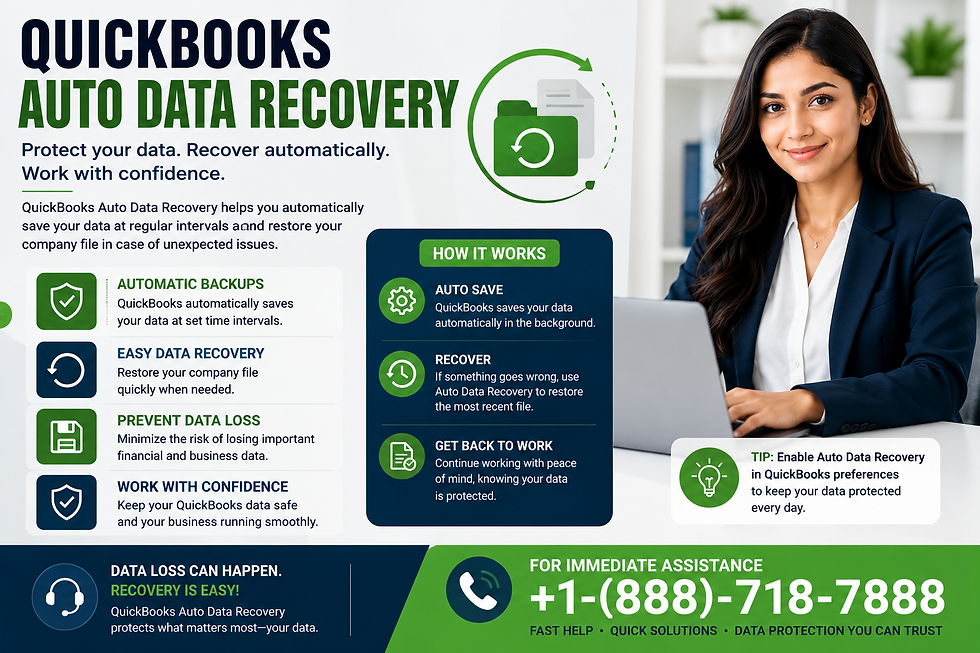
This automatic backup system secretly protects your transactions when your main company file gets damaged. In this complete guide, I will explain exactly what Auto Data Recovery is, why it sometimes fails, how to manually trigger it, and how to restore your data step by step. If you get stuck or the recovery process hangs, the official Intuit support team is standing by at +1-(888)-718-7888. Save that number now because when data vanishes, every minute costs money.
What Is QuickBooks Auto Data Recovery? (No Tech Jargon)
QuickBooks Auto Data Recovery is an automatic, background feature introduced in QuickBooks Desktop 2016 and newer (Pro, Premier, Enterprise, and Accountant editions). Think of it as a silent bodyguard for your company file. Every time you work in QuickBooks, ADR creates a separate, hidden copy of your data in a specific folder on your computer or server.
This copy updates automatically every few minutes while you work. If your main company file (the .QBW file) becomes corrupt, gets an error code, or will not open, QuickBooks will automatically prompt you to “recover” from the ADR folder.
Here is the critical part most people miss: Auto Data Recovery does not replace your regular manual backups. It is not a full system backup. Instead, it only recovers transactions and lists (customers, vendors, products) – not attachments, templates, or logos.
And it only works if the feature was enabled before the corruption happened. The default setting is ON for single-user mode and OFF for multi-user mode unless you manually enable it. Knowing this distinction saves hours of confusion.
When QuickBooks senses that your main company file is damaged, it will automatically display a message saying: “QuickBooks detected that your company file is damaged. Would you like to recover your data from the Auto Data Recovery folder?” If you see that message, do not click “No.” Click “Yes” immediately.
That simple click can restore 95% of your recent work. If you do not see that message, you can manually run the recovery process. And if the recovery fails or the folder is empty, call +1-(888)-718-7888 before attempting third-party repair tools – those often make things worse.
Also read:- QuickBooks Error PS034 can interrupt payroll updates and processing. Learn proven fixes to restore payroll functionality quickly and efficiently.
Why Does QuickBooks Auto Data Recovery Stop Working? (5 Real Reasons)
Auto Data Recovery is reliable, but it is not magic. It stops working for specific, fixable reasons.
1. Multi-User Mode with ADR Disabled (Most Common)
By default, ADR is turned OFF in multi-user mode. If you work on a network with two or more people, QuickBooks assumes your IT person handles backups. Result: no automatic recovery data is created. You must manually enable it.
2. Insufficient Disk Space on the Drive
ADR needs free space equal to roughly 1.5x your company file size. If your C: drive or the drive hosting the .QBW file has less than 1GB free, ADR pauses silently. No warning. No error. It just stops backing up.
3. Corrupted .TLG File (Transaction Log File)
Every QuickBooks company file has a .TLG file sitting next to it. The .TLG tracks every change since your last backup. If that file gets corrupted, ADR cannot read the latest transactions. The recovery attempt then fails with “unable to read data.”
4. Antivirus or Windows Defender Blocking the ADR Folder
ADR stores its data in C:\ProgramData\Intuit\QuickBooks\Components\AutoRecovery (hidden folder). Many antivirus programs see frequent writes to this folder as suspicious behavior and block QuickBooks from accessing it. When that happens, ADR thinks it is working, but no files are actually saved.
5. Using QuickBooks 2015 or Older
If you are running QuickBooks 2015 or earlier, you do not have Auto Data Recovery at all. The feature was introduced with version 2016. In that case, you need to rely on manual backups or the built-in “Backup and Restore” function. Upgrading is the real solution.
Full Detailed Solutions – Recover Your Data Now
Follow these steps exactly. Do not skip. Test after each section.
Solution 1: Automatic Recovery (When QuickBooks Prompts You)
This is the easiest scenario. If QuickBooks already detected the damage:
Open QuickBooks Desktop. Instead of opening normally, you will see a popup: “Recover from Auto Data Recovery?”
Click Yes.
QuickBooks will scan the ADR folder and show you a preview of what can be recovered (usually transactions from the last 12–24 hours).
Click Start Recovery.
Wait. This can take 10–45 minutes depending on file size. Do not interrupt it.
Once finished, QuickBooks will open a recovered version of your company file with “(Recovered)” in the title.
Save this recovered file as a new .QBW file (File > Save As > give it a new name like My Company_Recovered qbw).
If the automatic recovery does not start on its own or fails halfway, move to Solution 2.
Solution 2: Manually Run Auto Data Recovery (No Prompt Appears)
Sometimes QuickBooks does not offer the recovery automatically, but the ADR folder still contains good data.
Close QuickBooks completely. Use Task Manager to ensure no QBW32.exe is running.
Navigate to your company file location (where your .QBW file lives).
Look for a file with the same name as your company file but ending in .ADR or a folder named Auto Recovery next to your .QBW. If you see it, copy that entire folder to your desktop as a backup.
Open QuickBooks Tool Hub (download free from Intuit if you don’t have it).
Click Company File Issues > Run QuickBooks File Doctor.
In File Doctor, check the box that says “Recover from Auto Data Recovery folder” (this option only appears if ADR data exists).
Click Start Diagnosis.
Follow the on-screen prompts. File Doctor will merge the ADR data into a clean copy of your company file.
If File Doctor cannot find the ADR folder, the data is either missing or was never created. At this point, your remaining options are to restore from a manual backup or call support. Do not keep trying random fixes – each failed attempt can overwrite the ADR folder. Call +1-(888)-718-7888 for a remote session where a technician can undelete hidden ADR files using specialized tools.
Solution 3: Enable Auto Data Recovery for the Future (Prevention)
You never want to be in this situation again. Here is how to make sure ADR runs every single day.
For Single-User Mode (already on by default, but verify):
Open QuickBooks > Edit > Preferences.
Select General from the left menu.
Click My Preferences tab.
Ensure “Automatically recover data if company file is damaged” is checked.
Click OK.
For Multi-User Mode (must manually enable on the host computer):
On the computer that hosts the company file (the server), open QuickBooks.
Go to File > Switch to Single-user Mode (temporarily).
Follow the single-user steps above to enable ADR.
Go back to File > Switch to Multi-user Mode.
ADR will now run for all users. Repeat this on any computer that acts as a host.
Pro tip: After enabling ADR, test it. Make a fake test transaction (e.g., add a $1 invoice to a test customer). Close QuickBooks. Rename your main .QBW file to .OLD. Open QuickBooks again. If ADR is working, you will get the recovery prompt. If not, something is still blocking it.
Frequently Asked Questions (FAQ)
Q1 – Does Auto Data Recovery replace my regular backups?
No, absolutely not. ADR only recovers transactions. It does not recover attachments, custom forms, bank feeds rules, or preferences. Always maintain weekly manual backups to an external drive or cloud. Think of ADR as a seatbelt – it saves you in a fender bender, but it is not an airbag for a total crash.
Q2 – How far back does Auto Data Recovery go?
ADR keeps roughly 24–48 hours of transaction changes. It is not a historical archive. If your file got corrupted three weeks ago, ADR will only recover work from the last two days. For older corruption, you need a full backup from before the damage occurred.
Q3 – Can I recover a deleted invoice using Auto Data Recovery?
Yes, if the deletion happened within the last day or two and ADR was running. You would need to restore the entire recovered file, then manually export that single invoice into your main file. A support technician can guide this process – call +1-(888)-718-7888 for step-by-step help on partial recovery.
Q4 – Why does QuickBooks say “Auto Data Recovery not available for this company file”?
Two possibilities. First, your company file was created in a version older than 2016 and never upgraded. Second, you are in multi-user mode on a network where the host computer has ADR disabled. Switch to single-user mode temporarily to enable it.
Q5 – Will ADR slow down my QuickBooks?
Barely noticeable. ADR only saves changes every few minutes, and it runs at a low priority. On modern hardware with an SSD, you will never feel it. On an old mechanical hard drive with less than 500MB free space, you might notice a slight delay when saving a large batch of transactions. The solution is freeing up disk space, not disabling ADR.
Q6 – What if the ADR folder is empty or missing?
Check the hidden folder path: C:\ProgramData\Intuit\QuickBooks\Components\AutoRecovery (paste this into File Explorer). If that folder exists but is empty, ADR never ran. If the folder does not exist at all, your installation may be damaged. Run a clean install of QuickBooks, then re-enable ADR. If you need the folder recovered (undeleted files), do not write any new data to your drive – call 1-888-718-7888 immediately for data recovery assistance.
Final Checklist & When to Call Support
Before you give up, run this final checklist:
Confirmed you are using QuickBooks 2016 or newer (File > About QuickBooks)?
Checked that ADR was enabled before the corruption (Edit > Preferences > General)?
Searched for the hidden ADR folder and found files inside?
Tried QuickBooks File Doctor with the “Recover from ADR” option?
Tried opening the company file on a different computer (to rule out local drive failure)?
If you answered “No” to any of the above, especially the ADR folder check, your chances of self-recovery are low. At this point, every attempted fix risks overwriting the very data you need. The smart play is to call 1-888-718-7888.
The support team has enterprise-grade undelete software and direct access to Intuit’s internal repair tools. They can often pull the ADR folder even if Windows says it is empty. That number again is 1-888-718-7888 – keep it pinned to your desktop or write it on a sticky note attached to your monitor.
Final Words – Stop Losing Sleep Over Corrupt Files
QuickBooks Auto Data Recovery is one of the most underrated, misunderstood, and life-saving features in the entire Intuit ecosystem. Most users only discover it after a catastrophic file failure, and by then, they often panic and make things worse by renaming files or running unverified repair tools. Now you know better.
You know exactly what ADR is, why it fails (multi-user mode being the number one culprit), and exactly how to force a manual recovery using the QuickBooks Tool Hub. More importantly, you know that for complex cases involving missing .TLG files or empty ADR folders, professional help is just one phone call away at +1-(888)-718-7888. Do not let a single corrupted file ruin your week. Recover, verify, and get back to business.
Comments